
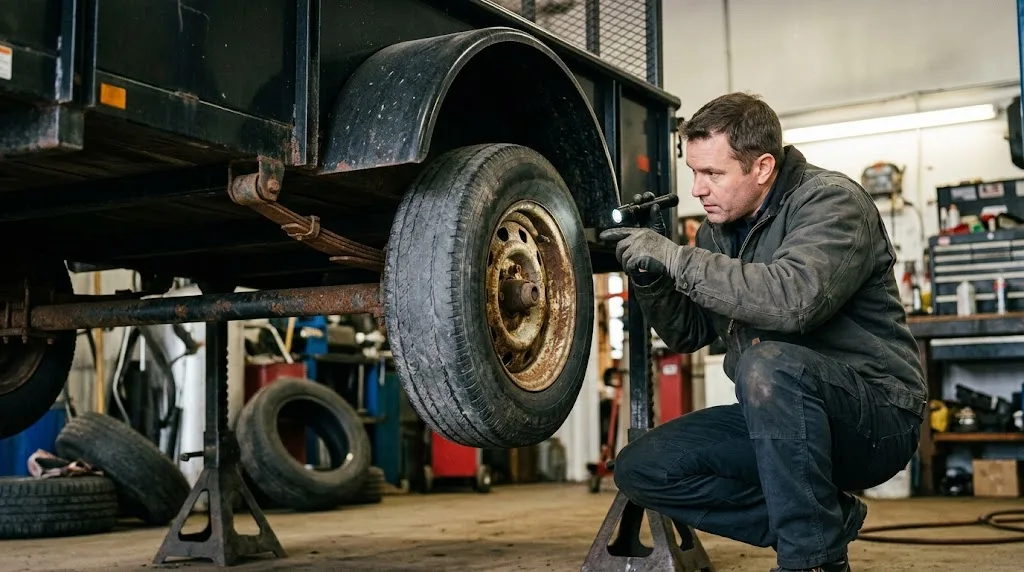
Just like the human body, your trailer will often give you subtle warning signs before a major breakdown occurs. A strange noise, a slight pull, or a flickering light might seem minor at first, but these are the "symptoms" of underlying mechanical issues that could eventually leave you stranded on the side of the highway.
At Dr. Trailer, we know that preventative maintenance is the best medicine. Learning to listen to and observe your equipment can save you from costly repairs and dangerous accidents. Here are the five critical warning signs that indicate your trailer needs to visit the "clinic" for an urgent checkup.
1. The Symptom: Irregular Tire Wear
The Diagnosis: Misaligned Axles or Suspension Fatigue If your tires are wearing out rapidly on one side, showing bald spots, or developing a wavy, "cupped" pattern, simply replacing the tire is like putting a band-aid on a broken bone. Irregular tire wear is almost always a symptom of a deeper structural issue.
This usually indicates that your trailer’s axles have been bent—often caused by hitting a severe pothole, overloading the trailer, or running on worn-out leaf springs that have lost their elasticity.
The Prescription: Before you ruin another set of tires, bring your rig in for a comprehensive axle and suspension alignment check. We will inspect the leaf springs, bushings, and axle tubes to ensure your trailer tracks perfectly straight.
2. The Symptom: Grinding, Squeaking, or Clunking Noises
The Diagnosis: Dry Wheel Bearings or Failing Bushings Your trailer should roll smoothly and quietly. If you hear a high-pitched squeal that increases with speed, or a harsh grinding noise coming from the wheels, your wheel bearings are crying out for help.
When the grease inside your wheel hub dries out or gets contaminated with water, the bearings experience extreme friction. If ignored, the intense heat can cause the bearing to literally weld itself to the axle spindle, resulting in a catastrophic wheel separation at highway speeds. A clunking noise over bumps usually points to metal-on-metal contact due to completely worn suspension bushings.
The Prescription: Immediate lubrication and inspection. Schedule a routine wheel bearing repack and inspection to replace degraded grease, swap out burnt bearings, and swap your worn bushings before the damage spreads to the axle itself.
3. The Symptom: Jerking or Delayed Braking
The Diagnosis: Desynchronized or Worn Brakes When you step on your tow vehicle's brakes, the trailer should decelerate in harmony with your truck. If you feel the trailer violently "pushing" your vehicle, or if the trailer tires lock up and skid easily, your braking system is severely compromised.
For electric brakes, this symptom points to worn-out brake shoes, faulty electromagnets, or a misadjusted in-cab brake controller. For surge brakes (common on boat trailers), it usually indicates low brake fluid or a seized actuator in the tongue.
The Prescription: A complete brake system diagnostic. You need an expert to measure the voltage reaching the magnets, test the breakaway battery, and adjust the brake shoes. Learn more about our trailer brake repair and safety services.
4. The Symptom: Flickering or Fading Lights
The Diagnosis: The "Nervous System" is Compromised Do your trailer’s running lights turn off when you hit the brakes? Do the turn signals barely glow? Electrical gremlins are the most frustrating ailments for trailer owners.
While a blown bulb is an easy fix, erratic lighting behavior almost always points to a bad ground connection. Salt, moisture, and road grime easily corrode the 7-way plug and the bare-metal ground screws on your chassis. Cracked wire casings can also trap moisture, causing the copper wires to rot from the inside out.
The Prescription: Stop relying on electrical tape. Your trailer needs a proper electrical diagnostic and wiring repair. We use marine-grade heat-shrink connectors and apply dielectric grease to seal out moisture, ensuring your lights are bright, legal, and reliable.
5. The Symptom: Flaking Rust and Hairline Cracks
The Diagnosis: Structural Metal Fatigue A little surface rust is normal on any hard-working steel trailer. However, if you notice large flakes of rust peeling the paint away at critical stress points—such as the A-frame tongue, the spring hangers, or the crossmembers—your trailer’s "bones" are deteriorating.
Worse than rust are hairline cracks in the welds. These usually occur after years of heavy hauling or chronic overloading, signaling that the structural integrity of the chassis is about to fail.
The Prescription: Structural issues require immediate, professional intervention. Our expert welding and fabrication team can grind away the damaged metal, reinforce the weak points with heavy-duty steel gussets, and apply protective coatings to stop rust in its tracks.
Don't Wait for a Breakdown
Ignoring these symptoms will only make the final diagnosis more expensive and increase your risk of an accident. If your trailer is exhibiting any of these warning signs, it’s time to consult the experts.
Don't leave your safety to chance. Contact Dr. Trailer today to schedule a comprehensive preventative maintenance checkup and get your equipment back to 100% health.